
Skip to content
About

Two people who have actually run the thing.

We're not an agency. We're an imam who builds software and a reliability engineer who keeps it standing. Between us we've shipped AI inside a real organization with a real budget and real people who didn't have time for a pilot program.

Portrait of Haris Qudsi

Haris Qudsi

Co-founder. Strategy, workflows, the talking.

Hey, I'm Haris. I serve as an imam, I lead AI implementation and marketing for a multi-million-dollar humanitarian nonprofit, and I build software in the hours between. People ask how those fit together. They fit the way anything fits: slowly, and with a lot of patience.

SimplyLean AI exists because of the nonprofit job. We had a team doing three roles each, a donor database that fought back, and a board that wanted to know what we were doing about AI. We didn't do a pilot program. We picked the one process that was eating the most hours, rebuilt it with AI in the boring middle and a person at the end, and then did the next one. It worked. Then business owners I know started asking me to come look at their inbox.

I'm the one you'll talk to. I'll tell you plainly what AI can do for you right now, what it can't, and which part of your process was broken before the computers got involved.

  • Leads AI implementation and marketing at HDF, a multi-million-dollar humanitarian nonprofit
  • Serves as an imam
  • Built SchedulEasy, a booking and contracts product for public speakers
  • Has never met a brisket he wouldn't cook for twelve hours
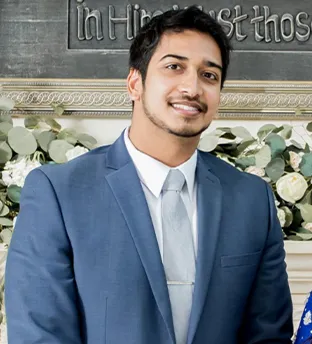
Portrait of Luthfe Siddique

Luthfe Siddique

Co-founder. Reliability, the building, the not-falling-over.

Luthfe is a reliability engineer. That's the person whose whole job is making sure the thing that's supposed to work at 2 a.m. works at 2 a.m., and that when it doesn't, somebody finds out before the customer does.

Most AI projects are built by people who are excited about AI. Ours are built by someone who's excited about the thing still running next year, after the model changes, the intern leaves, and somebody pastes a PDF where the spreadsheet goes. Luthfe designs for that day on purpose.

If I'm the one who says what we should build, Luthfe is the one who makes sure you never have to call us about it on a weekend.

  • Reliability engineer with years of experience keeping systems that are supposed to work, working
  • Owns the build, the monitoring, and the runbook
  • The reason our tools fail loudly instead of quietly
Two nonprofit staff reviewing a chart on a monitor, with donor thank-you cards pinned behind them
Where this started

A nonprofit with no time for a pilot program.

The first workflow we rebuilt was donor follow-up. A gift came in, three people got an email, somebody copied the details into a spreadsheet, somebody else wrote a thank-you, and a week later the finance team re-typed all of it. We left the thank-you to a person and gave the copying to a machine. It took a few weeks and saved a few hours every day.

That's still the whole method. Find the copying. Give it to the machine. Keep the person where the judgment is.

How we work

Four things you can hold us to.

Straight talk

If the honest answer is "you don't need this," you get that answer. It's cheaper for both of us.

Small, then bigger

One workflow first. The second one is easier once the first one is paying for itself.

Humans in the loop

AI drafts. People decide. We write down where the line is and we don't move it without you.

Built to be left

Everything we make is documented well enough that you can fire us. We'd rather you didn't, but you can.

Say hello

If you got this far, you probably have a Tuesday in mind.

Tell us what's eating it. We'll tell you whether AI is the fix, and what it would cost to find out properly.